
Data model
Data model
Section titled “Data model”Workspace├── Membership ── User└── Project ├── ApiKey ├── Prompt │ ├── PromptVersion (immutable versions) │ └── PromptChannel (movable deployment pointers) ├── Dataset │ ├── DatasetItem │ └── DatasetRun ── DatasetRunItem (links an item to its trace) ├── Evaluator └── ReviewQueue ── ReviewItem
Trace (telemetry, in Apache Doris)├── Observation (steps; nest via parentObservationId)└── ScoreRelational metadata (workspaces, projects, prompts, datasets, …) lives in Postgres;
high-volume Trace / Observation / Score telemetry lives in Apache Doris and is
linked by trace_id / project_id.
Tenancy
Section titled “Tenancy”- Organization → Project (the data model still names it
Workspacein places). All telemetry and config is scoped to a project; tenancy is the Better Auth organization plugin (organization/member/invitation). - Membership binds a user to an organization with a role:
OWNER,ADMIN,MEMBER,VIEWER. Viewers are read-only. - API keys are per-project (
pk-mt-…public,sk-mt-…secret); mint and revoke them from the console orPOST/DELETE /v1/api-keys. - SSO — customers can sign in with their own OIDC/SAML IdP (Better Auth SSO plugin), mapped to an organization by email domain.
Observability
Section titled “Observability”-
Trace — one logical request/run. Has a name, optional
userId,sessionId,sessionPath,release,version,environment, tags, metadata, input, output. -
Observation — a step inside a trace. Three kinds:
- span — generic unit of work
- generation — an LLM call (model, provider, token usage, cost, latency)
- event — a point-in-time marker
Observations nest via
parentObservationId, rendered as a waterfall timeline, and are also browsable on their own in the span explorer (Spans in the console,GET /v1/observations): a flat, filterable table over every span in the project, for questions like “everyretrieverspan over 2s this week” that a trace-level filter can’t express.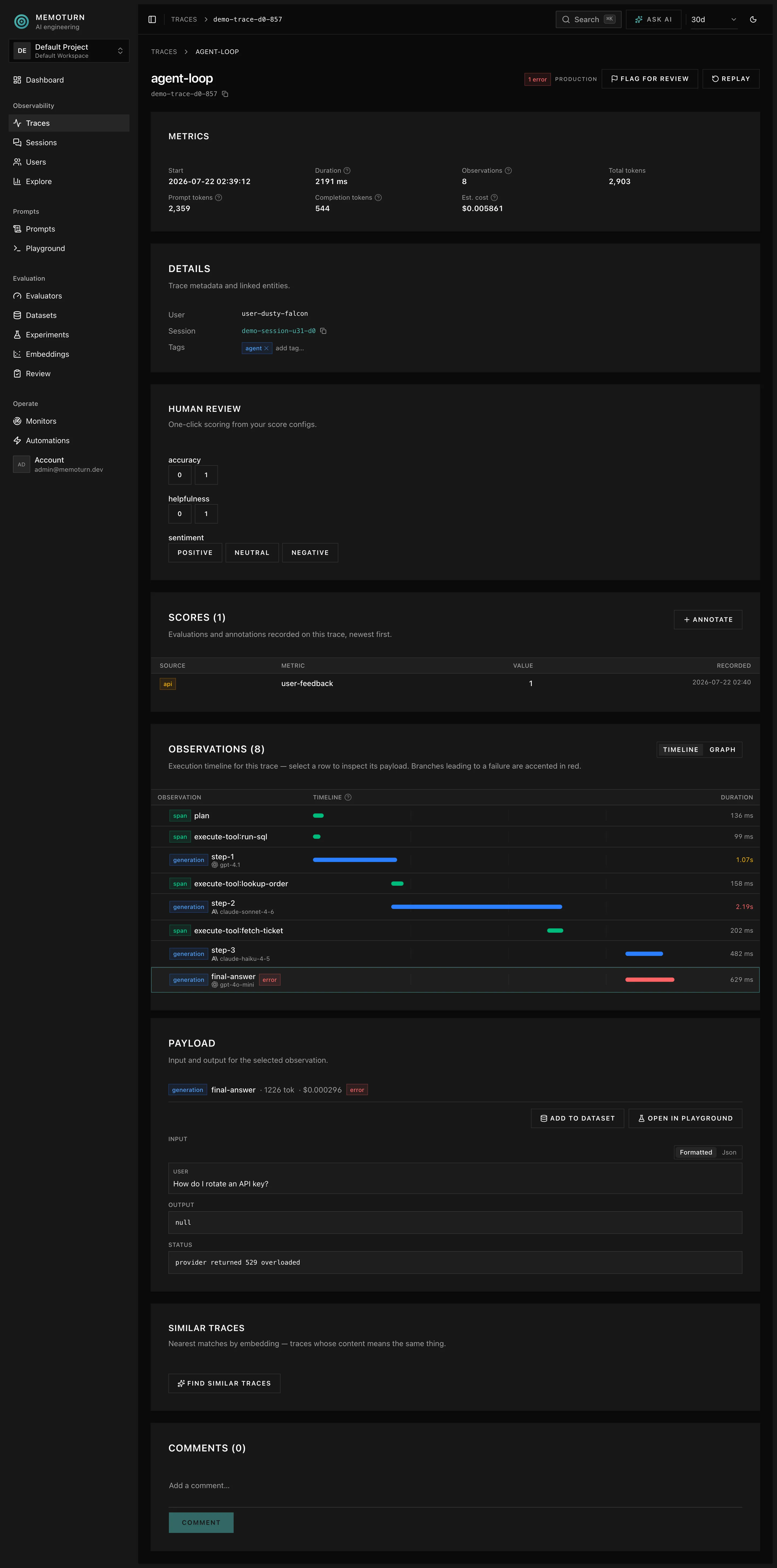
-
Score — a numeric/categorical/boolean measurement attached to a trace (or observation).
sourceis one of:API— sent via SDK/API (e.g. user feedback)EVAL— produced by an evaluator (LLM-as-judge)ANNOTATION— produced by a human review
-
Session — traces sharing a
sessionId(a conversation/thread). Sessions roll up trace counts and cost. An optionalsessionPath(a ”/“-delimited, function-organized path like/support/lookup-order) groups a session’s traces by function rather than time, so repeated work shares a path — surfaced as a column in the session view. -
Environment — free-form label (e.g.
production,staging,playground) for separating and filtering telemetry.
Cost is computed by the worker from the model + token usage using the registry in
packages/core (extend MODEL_PRICES to add models).
Metrics
Section titled “Metrics”Cost, tokens, counts, and latency percentiles (p50/p95/p99, via PERCENTILE_APPROX) are
aggregated on the fly from the observations table in Doris — per project, environment,
and model, grouped by day. The dashboard and GET /v1/metrics run these aggregations
directly; there is no precomputed rollup to drift out of date.
Prompt management
Section titled “Prompt management”- Prompt — named, optionally foldered. Versions are immutable; each save creates a new version.
- Channel — a movable deployment pointer (e.g.
production,latest, or custom).latestalways tracks the newest version. SDKs fetch by channel.
See Prompts.
Datasets & experiments
Section titled “Datasets & experiments”- Dataset — a set of items (
input, optionalexpectedOutput, metadata). - Run (experiment) — links each dataset item to the trace produced by running a task on it; scores on those traces are the experiment’s results.
Evaluators
Section titled “Evaluators”LLM-as-judge evaluators (judge prompt + provider/model) score traces and write an
EVAL score. They run two ways:
- Offline — over a dataset/experiment.
- Online — the worker samples incoming production traces and scores them automatically (per-evaluator sampling rate + optional trace-name filter).
Review queues
Section titled “Review queues”Human-in-the-loop annotation. A review queue holds traces to score manually;
submitting a review writes an ANNOTATION score and marks the item done.
See Evaluation for all three modes.
Score configs
Section titled “Score configs”A score config defines an allowed score name and shape (numeric range, categorical options, or boolean) so manual and automated scores stay consistent across a project.
Automations & webhooks
Section titled “Automations & webhooks”- Webhook — POSTs to a URL on an event (
score.createdsupports a low-score threshold). - Automation — a trigger→action rule: trigger (
score.created/trace.created/eval.completed) → action (webhookorslack). - Event sink — optionally forwards trace/score events to a product-analytics/CDP endpoint (PostHog-compatible capture API) for funnels/retention.
PII masking
Section titled “PII masking”An optional per-project masking policy redacts trace input/output at ingest using built-in and custom patterns, so sensitive data never lands in Doris or the blob log.
Audit log & retention
Section titled “Audit log & retention”- Audit log — records who did what (prompt/dataset/provider/evaluator/review/retention mutations) per project.
- Retention policy — optional per-project max age; a daily worker job deletes telemetry older than the policy (0 = keep forever).