Evaluation
Memoturn supports three evaluation modes; all write scores into Doris, surfaced
on the trace alongside API feedback scores.
Offline: Dataset + items ──► Experiment run ──► Evaluator ─────┐Online: Incoming trace ──► sampled? ──yes──► Evaluator ───────┼──► scores (Doris)Human: Review queue ──► Reviewer scores ─────────────────────┘ │ ▼ shown on the trace| Mode | Source | How |
|---|---|---|
| Offline | EVAL | Run an evaluator over a dataset/experiment |
| Online | EVAL | The worker samples production traces and scores them automatically |
| Human | ANNOTATION | Reviewers score traces in a review queue |
Datasets & experiments (offline)
Section titled “Datasets & experiments (offline)”- Create a dataset and add items (
input, optionalexpectedOutput). - Run your task over each item, producing a trace per item.
- Record a run linking items → traces (
POST /v1/datasets/{name}/runs, ordataset.recordRun()in the SDK). - Score the traces (via an evaluator or human review).
See the dataset example in TS SDK.
Dataset item contracts
Section titled “Dataset item contracts”A dataset that accumulates items from several people over months drifts: one row’s input is
{question}, the next is {query}, a third is a bare string. Nothing notices until an
experiment produces nonsense. A dataset can declare what its items must look like:
curl -u pk-mt-dev:sk-mt-dev -X PUT http://localhost:3001/v1/datasets/regression/schema \ -H 'content-type: application/json' -d '{ "input": { "required": ["question"], "properties": { "question": {"type":"string"}, "tier": {"type":"string","enum":["easy","hard"]} } }, "expectedOutput": { "type": "string" } }'This is a deliberate subset of JSON Schema — object shape, field types, required, enum —
because that is what dataset items actually look like, and a subset we fully implement beats a
superset we half-implement and silently ignore. Undeclared fields are allowed: a schema is a
floor, not a straitjacket.
Inserts are validated against it with per-field errors and partial acceptance, the same way ingest handles a bad event — rejecting a whole spreadsheet because row 40 is malformed makes the fix harder, not easier:
{ "added": 1, "rejected": 2, "errors": [ { "index": 1, "field": "input.question", "message": "required" }, { "index": 2, "field": "input.tier", "message": "must be one of: easy, hard" } ] }Declaring a schema does not re-validate existing items — silently invalidating history would
be a surprise. GET /v1/datasets/{name}/schema/check reports how many current items would fail,
so tightening a contract is a decision you make with the number in front of you.
Importing from CSV
Section titled “Importing from CSV”Most eval cases start life in a spreadsheet:
curl -u pk-mt-dev:sk-mt-dev -X POST http://localhost:3001/v1/datasets/regression/items/csv \ -H 'content-type: application/json' \ -d '{"csv":"question,answer,tier\nwhy?,because,easy\n", "mapping":{"input":["question","tier"],"expectedOutput":"answer"}}'The mapping is explicit rather than guessed — guessing would be right often enough to be trusted
and wrong often enough to corrupt a dataset quietly. Give input one column to use its cell
directly, or several to build an object keyed by column name. Unmapped columns are ignored.
Cells that look like JSON objects or arrays are parsed; a bare 123 stays a string, so order
numbers and ids keep their form.
Quoted commas, newlines inside quoted fields, escaped quotes, CRLF, and a leading BOM are all handled. A mapping that names a column the file doesn’t have fails the whole import — that is a mistake in the mapping, and importing half a file under a wrong one is worse than importing none of it. The console’s dataset page has the same flow: paste the CSV, pick the columns, import.
Remote dataset runs
Section titled “Remote dataset runs”An in-platform experiment executes every dataset item through memoturn’s provider gateway. That is useless to a team whose eval harness already exists — their prompts, tools, and retrieval live in their own service, and moving all of it here just to get a scored run isn’t a trade anyone should have to make.
Register a runner on the dataset instead:
# 1. Register your endpoint. The signing secret is returned ONCE.curl -u pk-mt-dev:sk-mt-dev -X PUT http://localhost:3001/v1/datasets/regression/runner \  -H 'content-type: application/json' -d '{"url":"https://your-harness.example/memoturn-runs"}'
# 2. Trigger a run (or click "Run remotely" on the dataset page).curl -u pk-mt-dev:sk-mt-dev -X POST http://localhost:3001/v1/datasets/regression/remote-runs \  -H 'content-type: application/json' -d '{"runName":"nightly-2026-08-12"}'
Your endpoint receives a signed POST:
{ "event": "dataset.run.requested", "projectId": "…", "dataset": "regression", "runName": "nightly-2026-08-12", "version": null, "itemCount": 42, "itemsUrl": "/v1/datasets/regression", "resultsUrl": "/v1/dataset-run-items" }The trigger is a pointer, never a copy of the dataset: it stays the same size whether the
dataset has 10 items or 100 000, and your runner pulls the items with its own API key — the
same documented endpoints a human would use. Verify authenticity exactly as for webhooks:
HMAC_SHA256(secret, "<timestamp>.<body>") against X-Memoturn-Signature, with the timestamp
in X-Memoturn-Timestamp.
Your harness then runs each item, sends traces through normal ingest, and links each result:
curl -u pk-mt-dev:sk-mt-dev -X POST http://localhost:3001/v1/dataset-run-items \ -H 'content-type: application/json' \ -d '{"datasetName":"regression","runName":"nightly-2026-08-12","datasetItemId":"…","traceId":"…"}'From there the run is an ordinary run: it appears in the comparison matrix, evaluators can score
its traces, and mt eval can gate on it.
Two things worth knowing. The run row is created before the trigger is sent, so a run that never reports back shows up empty rather than not at all — “their harness is slow” and “nothing happened” look different. And the trigger response tells you whether the runner accepted the request, not whether the run succeeded; the runner’s last status and error are kept on the dataset page.
Evaluators
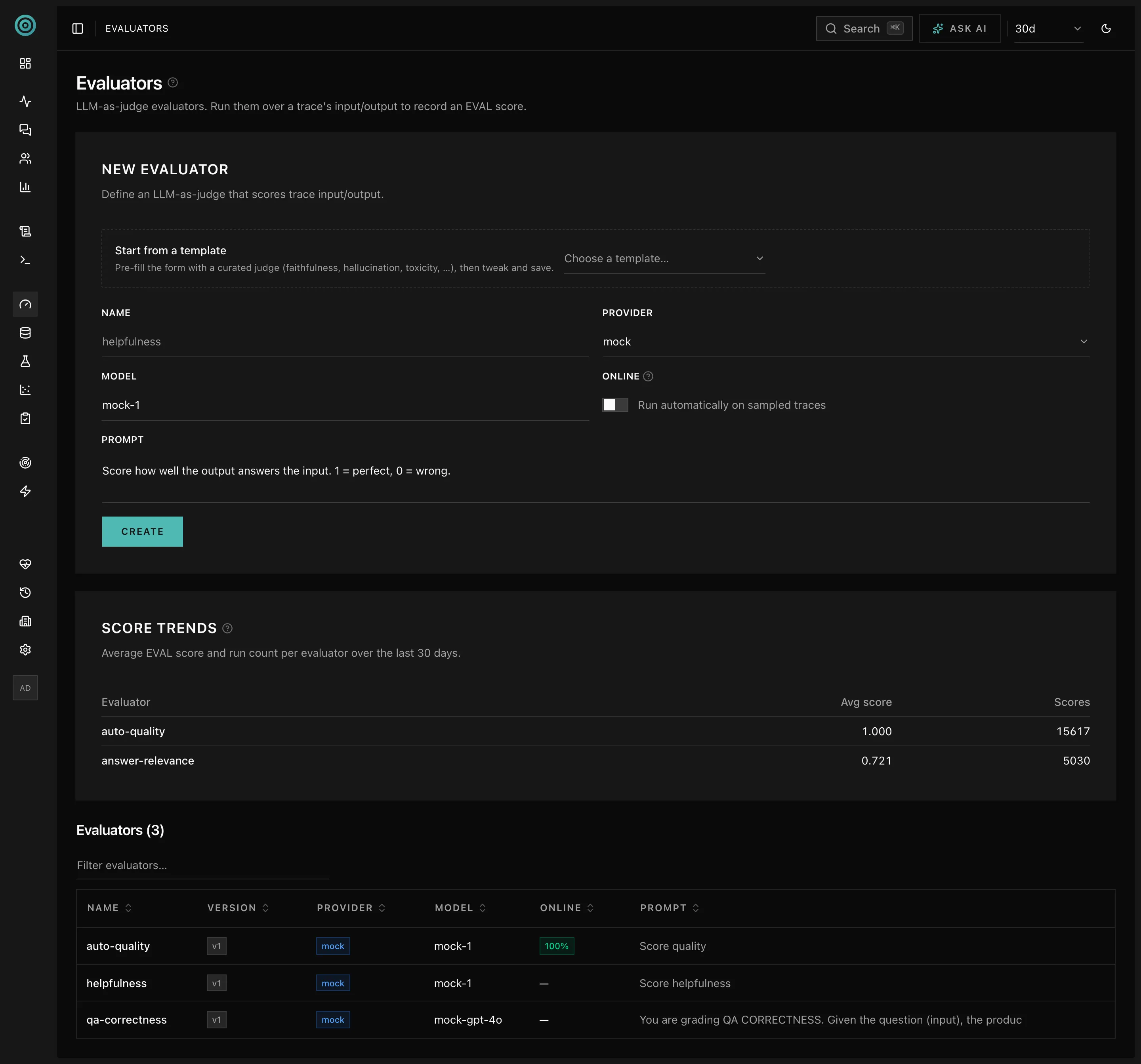
Section titled “Evaluators”An evaluator is a judge prompt + provider/model. Providers: mock (deterministic, no key
— for local testing), anthropic, openai.
# createcurl -u pk-mt-dev:sk-mt-dev -X POST http://localhost:3001/v1/evaluators \  -H 'content-type: application/json' \  -d '{"name":"helpfulness","prompt":"Score how well output answers input (0..1).","provider":"mock","model":"mock-1"}'
# run over a trace's input/output → writes an EVAL scorecurl -u pk-mt-dev:sk-mt-dev -X POST http://localhost:3001/v1/evaluators/helpfulness/run \  -H 'content-type: application/json' \  -d '{"traceId":"<id>","input":{"q":"…"},"output":"…"}'
The judge is asked to return strict JSON {"score": 0..1, "reasoning": "…"}.
The prebuilt library (GET /v1/evaluators/templates, instantiate via POST /v1/evaluators/from-template) covers RAG/quality dimensions plus conversation-quality
metrics (user frustration, knowledge retention, session completeness, conversational
coherence) and agent-trajectory metrics (trajectory accuracy, tool correctness, task
completion).
Code evaluators (deterministic checks)
Section titled “Code evaluators (deterministic checks)”Not every check deserves a model. “Is this valid JSON?”, “does it match ^[A-Z]{3}-[0-9]{4}$?”,
“is it under 500 characters?” have exact answers, and asking an LLM for them is slow, costly, and
less reliable than the obvious computation.
A code evaluator (kind: "CODE") is an expression instead of a judge prompt. It runs locally
— no provider call, no API key, no cost, and the same answer every time.
curl -u pk-mt-dev:sk-mt-dev -X POST http://localhost:3001/v1/evaluators \ -H 'content-type: application/json' \ -d '{"name":"json-contract","kind":"CODE","model":"n/a", "expression":"jsonValid(output) and jsonPath(jsonParse(output), \"$.status\") == \"ok\""}'Everything else works identically to an LLM evaluator: online sampling, thread scope, dataset experiments, guardrails, version history, and the EVAL score it writes.
The expression language
Section titled “The expression language”Expressions are evaluated against four variables — input, output, expected, metadata —
and must return a boolean (pass/fail → 1/0) or a number in [0, 1] for a graded score.
Anything else is an error rather than a silently coerced score.
| Operators | and or not (also && || !), == != < <= > >=, + - * / %, a ? b : c |
| Access | output.field, output["field"], output.items[0], output.length |
| Strings | contains startsWith endsWith lower upper trim words matches |
| JSON | jsonValid jsonParse jsonPath has exactMatch |
| Numbers | num abs round min max len isEmpty coalesce |
len(output) < 500not contains(lower(output), "i cannot")matches(output, "^[A-Z]{3}-[0-9]{4}$")exactMatch(output, expected)min(1, len(words(output)) / 50) # a graded score, not just pass/failhas(metadata, "score") and metadata.score > 0.5GET /v1/evaluators/presets returns a library of ready-made checks (regex, JSON shape, length,
exact match, …) that the console offers as a menu; picking one fills in an editable expression.
POST /v1/evaluators/test-expression dry-runs an expression against a sample item — the console
uses it for the “Try it” panel, and it reports the raw value even when that value isn’t a valid
score, which is exactly when you need to see it.
Why an expression language and not “just run JavaScript”
Section titled “Why an expression language and not “just run JavaScript””Evaluators are user-authored config that executes inside the shared ingest worker, so the language is safe by construction rather than by sandboxing:
- No
eval, noFunction, no host object graph, and no way to name anything not bound — there are no callable values, sooutput.constructor()is unparseable rather than merely blocked. - Property reads are
hasOwn-gated and__proto__/constructor/prototypeare refused. matches()rejects patterns with nested repetition (the ReDoS signature) using the same static check the PII-masking policy uses, and caps subject length.- Termination is structural — the language has no loops or recursion — with a node budget and a parser depth cap as backstops.
- It is dependency-free and portable: no
node:vm, no WASM, so it behaves identically in the worker, the API, and a future edge profile (see ADR-0003).
Expressions are compiled at write time, so a broken check is a 400 when you save it rather
than a silent per-event failure in the worker later.
LLM juries (ensemble judging)
Section titled “LLM juries (ensemble judging)”Pass jurors — a list of {provider, model} — to turn an evaluator into an ensemble. The
same judge prompt runs against every juror and the score is the mean of their votes
(a juror that errors is dropped; the panel only fails if all jurors do). This reduces
single-judge variance:
{ "name": "quality", "prompt": "…", "model": "mock-1", "jurors": [{ "provider": "openai", "model": "gpt-x" }, { "provider": "anthropic", "model": "claude-y" }] }Online evaluation
Section titled “Online evaluation”Enable online with a samplingRate (and optional filterName). After each ingest
batch, the worker runs enabled online evaluators on the batch’s completed traces
(those carrying an output), deterministically sampled by hash(traceId:evaluator):
{ "name": "auto-quality", "prompt": "…", "provider": "mock", "model": "mock-1", "online": true, "samplingRate": 1.0, "filterName": "" }Thread (conversation) evaluation
Section titled “Thread (conversation) evaluation”Set scope: "thread" (with online: true) to score whole conversations instead of single
traces. A per-minute worker cron finds sessions that have been quiet for cooldownSeconds
(default 900), assembles the session transcript, judges it, and writes one score to the
session’s latest trace — so multi-turn conversations “settle” before being judged:
{ "name": "user-frustration", "prompt": "…", "provider": "mock", "model": "mock-1", "online": true, "scope": "thread", "cooldownSeconds": 900 }What a judge emits
Section titled “What a judge emits”By default a judge is asked for {"score": 0..1, "reasoning": "…"}, and the result is recorded
as a NUMERIC score. Plenty of judgements aren’t a number, so an evaluator can declare what it
produces:
scoreDataType | The judge is asked for | Recorded as |
|---|---|---|
NUMERIC (default) | {"score": 0..1, "reasoning"} | numeric value |
CATEGORICAL | {"label": "…", "reasoning"} | stringValue, no numeric value |
BOOLEAN | {"pass": true/false, "reasoning"} | value 1 or 0 |
{ "name": "failure-mode", "prompt": "Classify the failure, if any.", "scoreDataType": "CATEGORICAL", "scoreCategories": ["hallucination", "refusal", "wrong-tool", "ok"] }scoreCategories is a contract, not a hint: a judge that answers off-list has its label
rejected (and the attempt recorded in the reasoning) rather than silently creating a new
category, which would fragment the score’s own distribution. Leave it empty to accept anything.
scoreName records the score under a different name than the evaluator — use it when two
evaluators should write the same score, e.g. a v2 judge replacing a v1 so their values stay
comparable on one timeline.
Two consequences worth knowing:
- A categorical score has no numeric value at all — not a zero. It never drags an average down, and it can’t back an evaluator guardrail (which is a numeric threshold); a guard pointed at a categorical evaluator is skipped and logged rather than compared against a stand-in zero. Compare labels on the Scores page instead.
- An LLM jury aggregates labels by majority vote, not by mean.
Observation (span) evaluation
Section titled “Observation (span) evaluation”Set scope: "observation" to score individual spans instead of whole runs — one score per
span, attached to the observation. filterName then matches the SPAN name, so a judge can
target exactly the step you care about:
{ "name": "context-relevance", "prompt": "…", "provider": "mock", "model": "mock-1", "online": true, "scope": "observation", "filterName": "retriever" }Variable mapping
Section titled “Variable mapping”By default a judge sees the trace’s input, output, and expectedOutput. That makes some
judges impossible to express: “is the retrieved context relevant to the question?” needs the
retriever span’s output, not the final answer. variableMapping binds each variable the
prompt references to a chosen source:
{ "name": "context-relevance", "prompt": "Does the context {{context}} support answering {{question}}? Score 0..1.", "variableMapping": [ { "variable": "question", "source": "trace.input", "jsonPath": "q" }, { "variable": "context", "source": "observation.output", "observationName": "retriever" } ] }Sources are trace.input|output|metadata, observation.input|output|metadata (with
observationName selecting the span), and dataset.input|expectedOutput|metadata (experiment
runs). jsonPath is an optional dotted path into the selected value (docs.0.text). The judge
receives exactly the mapped variables as its payload, and {{name}} references in the prompt
are substituted. An unresolvable binding becomes null rather than failing the run, and an
empty mapping keeps the built-in binding — so existing evaluators are unaffected.
Code evaluators get the mapped variables as additional bindings alongside input,
output, expected, and metadata, so an existing expression keeps working.
Backfill (scoring existing traces)
Section titled “Backfill (scoring existing traces)”Online evaluation only ever sees new traffic, so a judge published today has nothing to say about yesterday. A backfill runs an evaluator over traces you have already ingested, targeted with the same window + structured filter set the traces list uses:
# how many traces would this score?curl -u pk-mt-dev:sk-mt-dev 'http://localhost:3001/v1/evaluators/backfills/preview?days=7'
# queue it (returns immediately; poll GET /v1/evaluators/backfills for progress)curl -u pk-mt-dev:sk-mt-dev -X POST http://localhost:3001/v1/evaluators/helpfulness/backfill \  -H 'content-type: application/json' -d '{"days":7}'
The run executes on the worker (each trace is a judge call), reports processed/failed
counters as it goes, and is capped at 5000 traces per run — the cap is recorded on the run,
never applied silently. Score ids are deterministic in (target, evaluator), so re-running
overwrites instead of duplicating. Thread-scope evaluators can’t be backfilled: they are driven
by session settling, not by a trace selection.
CI gates (mt eval)
Section titled “CI gates (mt eval)”mt eval (shipped with the JS SDK) gates a dataset run’s evaluator score means against
thresholds and exits non-zero on a regression — drop it into CI to fail a PR on eval drift.
See the TypeScript SDK docs and POST /v1/datasets/{name}/runs/{run}/gate.
Score analytics
Section titled “Score analytics”The Scores page answers “is this score trustworthy?”.
One score at a time: summary statistics (count, mean, median, standard deviation), the shape of its values (a 10-bucket histogram for numeric scores, label counts for categorical ones), and a daily timeline — where a step usually means a config change rather than model drift.
Two scores at a time is the more valuable half: pick a second score and the page compares the two sources over the traces that carry both. That is how a team proves a judge is trustworthy — human vs judge, judge vs judge, or v1 vs v2 of the same judge:
- Numeric pairs → Pearson correlation (do they rank traces the same way?), MAE and RMSE (how far apart are they in absolute terms?).
- Label pairs → agreement rate, Cohen’s Kappa (agreement corrected for chance — two raters who always say “pass” agree 100% of the time and score 0), and per-label F1.
- Both → a confusion matrix; the diagonal is agreement and everything off it is where the two sources part ways. Numeric values are bucketed first.
The pair join is the widest query in the product, so it scans at most 20 000 pairs; past that the statistics are computed over a sample and the result says so rather than presenting a partial number as a total.
Human review queues
Section titled “Human review queues”# create a queue + enqueue tracescurl -u pk-mt-dev:sk-mt-dev -X POST http://localhost:3001/v1/review-queues \ -H 'content-type: application/json' -d '{"name":"q1","scoreName":"human-rating","dataType":"NUMERIC"}'curl -u pk-mt-dev:sk-mt-dev -X POST http://localhost:3001/v1/review-queues/q1/items \ -H 'content-type: application/json' -d '{"traceIds":["<id>"]}'
# reviewer submits a score (writes an ANNOTATION score, marks item done)curl -u pk-mt-dev:sk-mt-dev -X POST http://localhost:3001/v1/review-queues/q1/items/<itemId>/score \ -H 'content-type: application/json' -d '{"value":0.8,"comment":"looks good"}'The console Review page shows each pending item’s trace input/output with an inline scoring form.
Evaluator runs and their scores are visible on the Evaluators page: